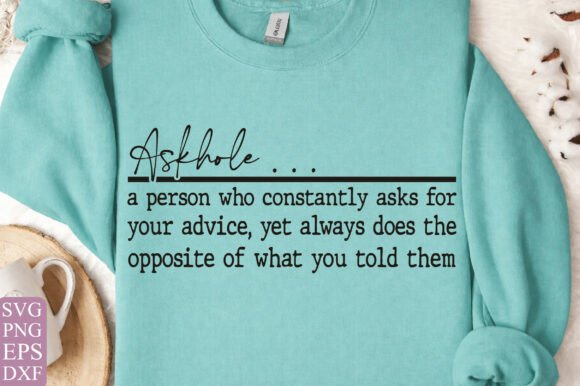
Askhole SVG: A Designer's Take on This Funny Graphic
As a professional designer who spends countless hours converting digital assets into tangible stitched goods, I approach every new file with a critical eye. The market is flooded with T-Shirt Designs and generic Graphics, but finding one that balances humor with technical viability is rare. Recently, I evaluated the Askhole SVG, Definition Askhole, Funny design to see if it holds up under the scrutiny of real-world embroidery work. My goal was not just to admire the joke, but to determine if this machine embroidery design would survive the transition from a screen to a fabric surface without losing its punch.
First Impressions: Visual Impact and Design Intent
When I first opened the Askhole SVG, Definition Askhole, Funny file in my vector software, the immediate reaction was a chuckle. The concept relies on wordplay that appeals to a specific demographic—likely parents, teachers, or anyone who appreciates dry, slightly irreverent humor. Visually, the layout is clean, which is essential for any digital product intended for apparel. The typography is bold enough to suggest it will read well at a distance, a crucial factor for custom apparel where legibility often gets lost in stitch density.
However, the true test lies in how the shapes translate to thread. In the context of Graphics meant for cutting, sharp corners are fine. But for an embroidery project, those same corners can be problematic depending on the needle angle and fabric tension. The design feels like it belongs on a sweatshirt or a tote bag rather than a delicate baby item. It has a personality that demands a sturdy canvas, something that can support the weight of the thread without distorting the comedic timing of the text.
Real-World Application: From File to Finished Product
To truly understand the potential of Askhole SVG, Definition Askhole, Funny, I visualized a specific scenario: creating a limited-run batch of embroidered patches for a local craft fair. Patches are forgiving because they use stabilizer heavily, but they also require crisp edges. If I were to digitize this for a patch, the fill stitch areas would need to be dense enough to prevent the backing from showing through, while the satin stitch borders would define the lettering.
Imagine placing this design on a heavy cotton tote bag. The texture of the canvas adds character, but it also challenges the needle. The stitch density must be high enough to anchor the thread into the weave without puckering the fabric. For a small shop product like this, the design acts as a conversation starter. Customers browsing a booth might pick up the bag, read the definition, and immediately connect with the brand's sense of humor. That moment of recognition is what drives sales in the handmade sector. Whether you are an Etsy seller looking for unique inventory or a creative entrepreneur building a boutique line, the ability of a design to spark engagement is its most valuable asset.
Consider the application on a sweatshirt. Sweatshirt embroidery requires careful consideration of the fleece texture. The loops in the fabric can sometimes swallow finer details. With Askhole SVG, Definition Askhole, Funny, the larger font sizes help mitigate this risk. However, if the design includes tiny decorative elements or small text within the definition, those could get lost in the pile of the fabric. In such cases, simplifying the embroidery file by removing minute details ensures the final result remains legible and professional.
Navigating Technical Challenges and Fabric Limitations
While the design is promising, there are scenarios where caution is required. Embroidering on thin or stretchy fabrics, such as jersey t-shirts, presents a significant challenge. The tension required to pull the thread through can distort the shape of the letters, making the "Askhole" pun look warped rather than witty. To avoid this, using a tear-away stabilizer is non-negotiable. Even then, the hoop size matters. If you attempt to fit this design into a very small hoop, the compression of the fabric around the edges can cause the stitching to bunch up, ruining the aesthetic of the finished product.
Dark fabrics also demand attention. The default colors in the PNG File preview might look great on white, but on black denim or navy wool, contrast becomes king. You cannot simply rely on the provided color palette; you must manually adjust the thread colors to ensure the text pops. White or bright neon threads usually work best for definitions like this against dark backgrounds. Furthermore, curved surfaces like caps are tricky. The curvature of a baseball cap can stretch the bottom row of text. Before committing to a full run of caps, always test the design on a scrap piece of similar material to see how the curve affects the readability of the running stitch and fill patterns.
Strategic Considerations for Craft Businesses
For those running a craft business, the value of Askhole SVG, Definition Askhole, Funny extends beyond the single design. It serves as a versatile asset for various seasonal campaigns. Think about holiday embroidery projects or back-to-school gear. A personalized gift featuring this design could be a hit for teachers or students. However, professionalism is key. A poorly executed stitch job can undermine the quality of your entire brand. If the threads are tangled or the registration is off, the customer perceives the whole handmade product as low quality, regardless of how funny the text is.
Licensing is another critical aspect. The product description mentions a ZIP folder containing an SVG, EPS, PNG, and transparent background files. While these formats are excellent for cutting machines and print-on-demand services, you must verify the license terms before selling finished items. Does the license allow for commercial embroidery? Can you sell the digital embroidery file itself, or only the physical goods made from it? As a responsible designer, I always recommend reading the terms thoroughly to protect your business interests. Selling unauthorized designs can lead to legal issues that no amount of humor can resolve.
Practical Designer Notes for Success
If you decide to incorporate Askhole SVG, Definition Askhole, Funny into your workflow, follow these practical steps to ensure success:
- Test on Scrap Fabric: Never skip this step. Stitch the design on a swatch of the exact fabric you plan to use. Check for puckering, thread breakage, and clarity.
- Review Stitch Density: Ensure the fill stitches are tight enough to cover the backing but loose enough to remain flexible.
- Check Hoop Size: Confirm the design fits comfortably within your hoop without excessive stretching of the fabric.
- Inspect Small Details: Zoom in on the smallest parts of the text. If they are too fine, consider simplifying them to prevent thread buildup.
- Use Proper Stabilizer: Match the stabilizer type to your fabric weight. Heavyweight stabilizers are often needed for thick materials like hoodies.
- Mockup in Black and White: Create a grayscale version to check contrast levels before selecting expensive thread colors.
- Verify Licensing: Double-check that your usage aligns with the commercial rights provided with the download.
In conclusion, Askhole SVG, Definition Askhole, Funny is a strong candidate for adding personality to your product line. It offers a blend of humor and visual clarity that works well for custom apparel and personalized gifts. However, its success depends entirely on your execution. By respecting the technical limitations of embroidery and taking the time to test thoroughly, you can turn this digital graphic into a high-quality, engaging physical product that customers will love. Whether you are making a single embroidered patch or launching a full collection, thoughtful preparation is the bridge between a good idea and a great finished piece.